
Africa is entering a decisive decade for solar power. Industry estimates put the continent’s solar market at roughly $14 billion in 2025, with analysts projecting it will climb toward the $21 billion mark by 2034 — a steady mid-single-digit annual growth rate driven less by subsidy programs than by simple economics: solar has become the cheapest way to get electricity to people who don’t have it yet.
That framing matters. In much of the world, solar competes with an already-built grid. In Africa, it is often competing with nothing at all — and against that baseline, it wins easily.
An Energy Deficit the Size of a Continent
More than half a billion people across sub-Saharan Africa still have no connection to an electrical grid, and rural electrification rates in many countries sit well below a third of the population. That gap has shaped the entire character of Africa’s solar buildout. Rather than following the utility-scale-first path taken by China, the United States, or Europe, Africa’s solar sector grew from the bottom up: solar lanterns, then solar home systems, then mini-grids, and only more recently, large grid-connected plants.
Pay-as-you-go financing has been the unlock. Companies such as M-KOPA and Lumos pioneered a model where customers pay small daily or weekly amounts — often through mobile money — toward ownership of a solar home system, sidestepping the need for a bank loan or large upfront cash. Between them and a wave of imitators, well over a million households have been connected this way, and tens of millions of individual solar lighting and power products have shipped across the continent since the mid-2010s.
Underpinning all of this is a cost curve that has moved dramatically in solar’s favor. Global panel prices have fallen by roughly 90% since 2010, and in Africa’s best locations, utility-scale solar now generates electricity for a few cents per kilowatt-hour — cheaper than any fossil-fuel alternative and, in many markets, cheaper than extending the existing grid.
The Geography Is on Solar’s Side
Africa’s solar resource is exceptional by global standards. Much of the continent sees more than 300 clear-sky days a year, and average daily solar potential exceeds 5 kWh per square meter — ahead of most of Europe and North America. The Sahara alone represents a theoretical generation potential that dwarfs current global electricity demand many times over.
Combined with vast tracts of sparsely populated, arid land in countries like Namibia, Sudan, and Algeria, this gives Africa some of the best conditions anywhere for utility-scale solar farms that don’t compete with agricultural land. As transmission infrastructure slowly improves and people want to buy solar panels in Nairobi and other areas, this resource base is expected to make solar the backbone of the continent’s long-term electricity mix rather than a supplementary source.
Photovoltaic Leads, Concentrated Solar Power Accelerates
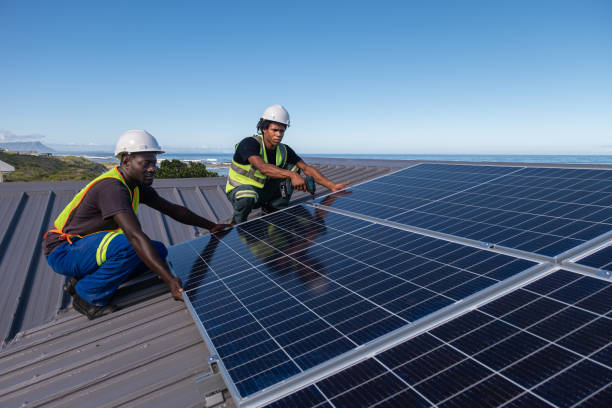
Solar photovoltaic technology dominates Africa’s installed base today, and for good reason: PV panels are modular, meaning they scale from a single rooftop to a multi-hundred-megawatt plant without fundamentally different engineering. That flexibility suits a continent where the market ranges from individual rural households to national utilities simultaneously. The large majority of new solar capacity added across sub-Saharan Africa over the past several years has been PV, helped along by falling import tariffs and, in countries like Kenya and South Africa, the emergence of local module assembly that shortens delivery times.
Concentrated solar power (CSP) occupies a smaller footprint — a low single-digit share of total capacity — but is growing markedly faster than PV in percentage terms. CSP’s advantage is dispatchability: unlike PV, it can store heat in molten salt and keep generating for several hours after sunset, which matters in grids trying to absorb large amounts of variable renewable power. Morocco’s Noor Ouarzazate complex, among the largest CSP installations in the world, is the standard-bearer for the technology on the continent, and further CSP capacity is being planned across the Sahel as part of broader efforts to pair solar with reliable baseload and evening peak supply. An analysis of growth drivers, market constraints, country opportunities, and competitive landscape shows a growing demand for solar power.
Country Snapshots
Kenya
Kenya is East Africa’s clearest solar success story. Grid-connected capacity has passed 400 MW, anchored by projects like the Malindi Solar Plant, while the country also has the highest concentration of pay-as-you-go solar home systems on the continent. This is an indication that a growing section of the population prefers to buy solar panels in Nairobi. Two factors explain the density of adoption: supportive policy — including a feed-in tariff and the removal of import duties on solar components — and near-universal mobile money penetration through M-Pesa, which makes small, frequent solar payments frictionless even in remote areas.
Ghana
Ghana has built its solar push around a national target of 40% renewables in its electricity mix by 2030. Utility-scale plants such as the Bole Solar Project and the Kaleo Solar Plant support grid stability, while tax exemptions on solar equipment have cut import costs meaningfully and encouraged private and commercial adoption, even though electricity access nationally is already comparatively high.
Tanzania
Tanzania started from a lower electrification base — under 40% of the population had grid access as recently as a few years ago — but has moved quickly through its Rural Energy Agency, which has rolled out over a thousand solar mini-grids since 2018. A competitively tendered 50 MW plant in Singida, procured through the World Bank-backed Scaling Solar program, delivered one of the lowest solar tariffs in East Africa at the time, and the exclusion of VAT on solar imports has kept the pipeline of private investment moving.
Uganda
Uganda still has an electrification rate around 40%, and its solar growth has been shaped as much by what’s held it back as by what’s pushed it forward: regulatory delays have stalled a meaningful amount of planned capacity, even as programs like the Electricity Access Roll-Out Program fund mini-grids and de-risking mechanisms like the Renewable Energy Performance Platform try to unstick private investment.
Beyond these four, South Africa, Egypt, and Morocco remain the continent’s largest markets by installed capacity, with Nigeria and Ethiopia representing enormous, still largely untapped potential in solar home systems and off-grid electrification.
What’s Holding the Market Back
Africa’s solar story isn’t one of unconstrained growth — several structural issues are slowing what could otherwise be an even faster buildout.
Grid infrastructure is the most immediate constraint. A substantial share of the continent’s transmission and distribution network is outdated or already running past capacity, and technical losses on African grids run close to double the global average. Fewer than a third of African countries have grid codes robust enough to properly absorb variable solar generation, which limits how much utility-scale solar a national grid can take on before stability becomes a concern.
Financing costs are the second major brake. Africa receives a strikingly small share of global climate finance relative to its population, and the cost of capital for a solar project in sub-Saharan Africa typically runs several times higher than in developed markets. That gap alone can be the difference between a project penciling out and not, since financing costs are a dominant component of the levelized cost of solar electricity. Relatively few African banks currently offer dedicated green financing products, which compounds the problem for developers trying to raise local capital.
Regulatory fragmentation adds friction on top of the financing gap. Only about half of African countries have clear net metering rules, and a majority of renewable projects on the continent experience delays tied to inconsistent permitting. The absence of standardized power purchase agreement templates raises transaction costs for every new project and makes it harder for developers to replicate a successful deal from one country to the next.
A shortage of trained technicians rounds out the list. Africa will need a very large number of certified solar technicians by the end of the decade to install and maintain the systems already being deployed, but current vocational training output falls well short of that need — in Kenya, for instance, only a minority of solar technicians hold formal certification today. Left unaddressed, this gap threatens the long-term reliability of systems that are otherwise sound investments.
Where the Next Wave of Growth Will Come From
Several opportunities stand out as the market matures.
Solar-powered agriculture is arguably the largest underexploited opportunity on the continent. Agriculture employs a majority of Africa’s workforce, yet only a small fraction of cultivated land is irrigated, largely for lack of affordable power. Solar irrigation pumps are already showing yield improvements in pilot programs in Ghana and Senegal, and millions of hectares of farmland could plausibly be brought under solar-powered irrigation by 2030. Solar cold storage is a related opportunity: post-harvest losses affect a large share of Africa’s perishable produce today, and refrigeration powered by off-grid solar could meaningfully cut that waste.
Regional power trading is another growth avenue. Power pools like the Southern African Power Pool already facilitate over a billion dollars in annual cross-border electricity trade, and the West African Power Pool has ambitious plans to bring several gigawatts of new renewable capacity online by 2030, with solar expected to supply the majority of it. A continent-wide electricity trading framework, targeted for the end of the decade, would let countries with abundant sun — Namibia and Zambia, for example — sell surplus solar power to neighbors with less favorable resources.
Corporate and industrial demand is quietly becoming a major driver too, as mining and agro-processing firms sign direct power purchase agreements with solar developers to secure reliable, cost-predictable electricity independent of unstable national grids.
Who’s Building It
Africa’s solar sector doesn’t have a single dominant player the way more mature markets do — instead, it’s a mix of international developers, regional utilities, and off-grid specialists each focused on a different part of the market. Companies like Engie and Scatec build and operate utility-scale plants while also running decentralized energy-access arms serving rural mini-grids. Gulf-backed developers such as Masdar have brought project financing and arid-climate engineering expertise to projects from Ghana to the Democratic Republic of Congo. Meanwhile, pay-as-you-go specialists like M-KOPA and Zola Electric continue to dominate the household end of the market. The strategies that separate winners from also-rans increasingly come down to localization — training technicians, assembling components domestically, and building distribution and financing models suited to specific national markets — rather than simply having the lowest-cost hardware.
The Outlook
Africa’s solar market is not going to grow in a straight line — grid limits, financing costs, and regulatory patchwork will keep it uneven from country to country. But the underlying case is hard to argue with: unmatched solar resource, a still-enormous population without reliable power, and a cost structure that increasingly favors solar over every competing option. The countries and companies that solve the financing and infrastructure bottlenecks fastest are likely to capture a disproportionate share of the growth ahead, but the direction of travel for the continent as a whole looks set for the long term.